A003 · PK/AI/Shadow-AI/Office-Data-Leak/Nobody-Approved
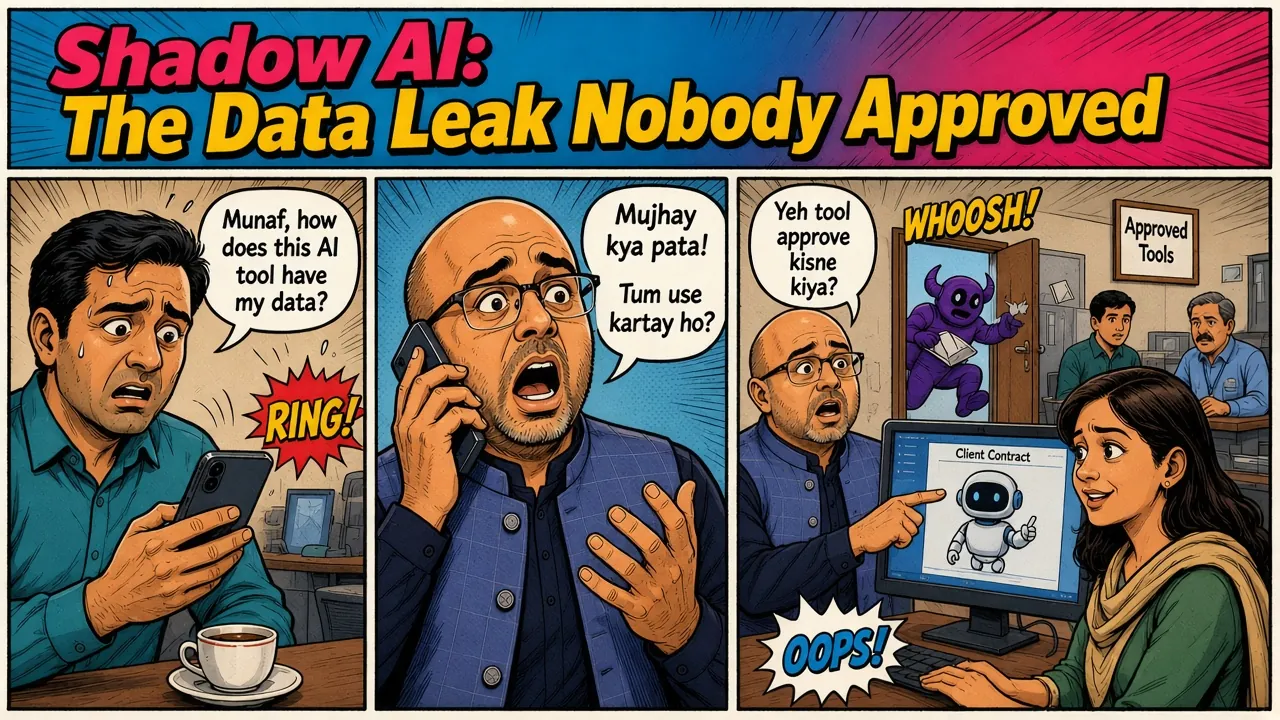
Shadow AI: The Data Leak Nobody Approved
Nobody approved the tool. Nobody owns it. And the data may already have left. Here's what Pakistani CIOs, CISOs and smaller businesses can do this quarter.
· 11 min read · Originally published on LinkedIn ↗
In 60 seconds (yeh article kya cover karta hai)
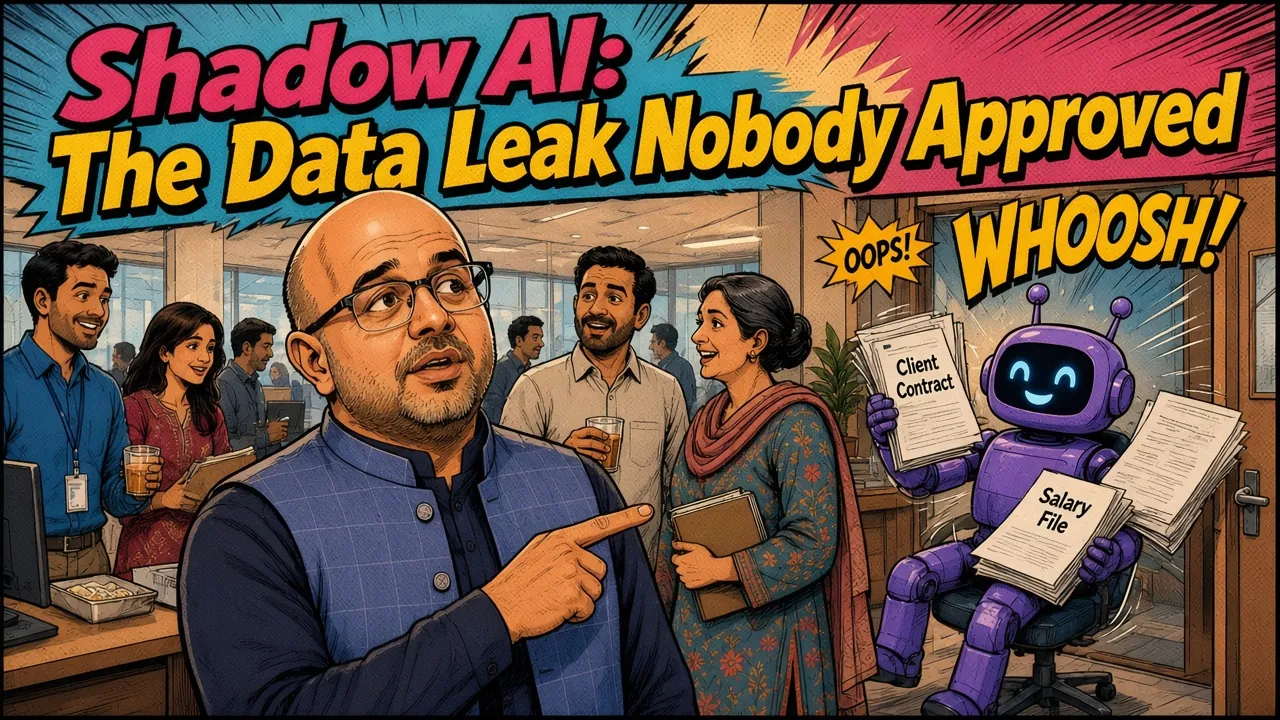
Shadow AI hota kya hai?
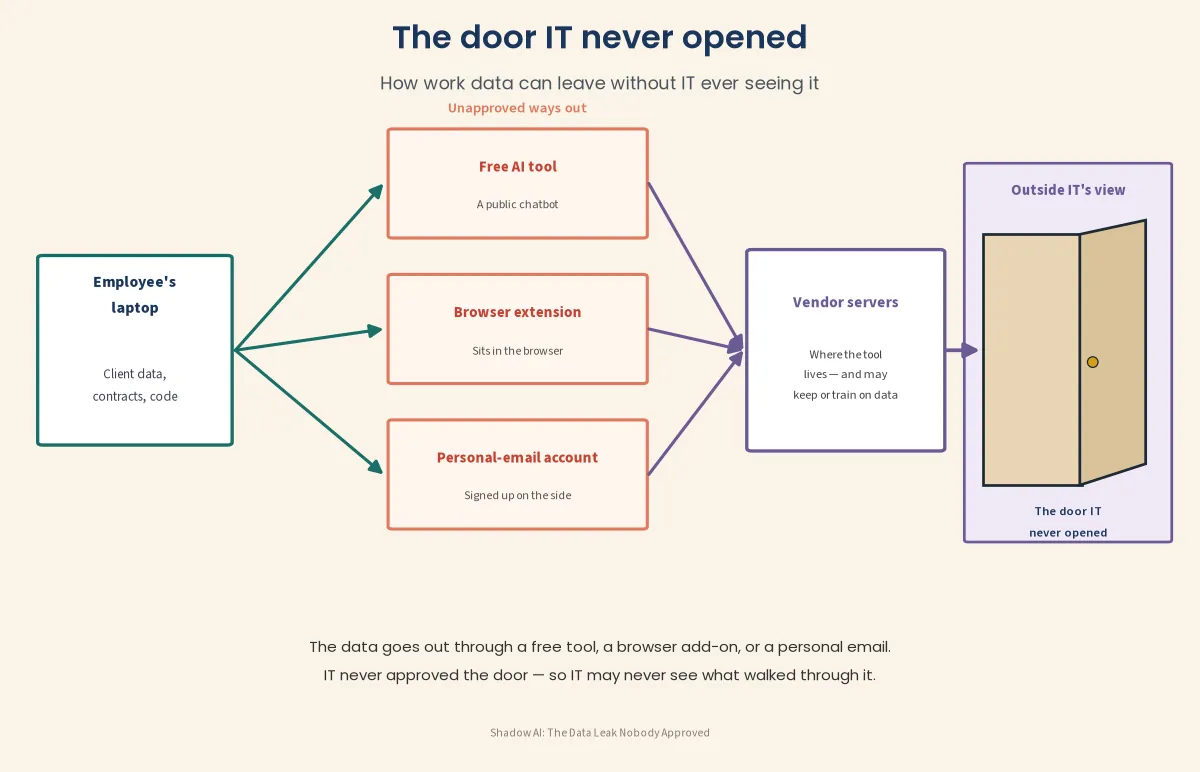
Shadow AI is any AI tool people use for work without the company knowing, approving or protecting it.
Seedhi baat yeh hai: koi free chatbot, koi browser extension, ya personal email se khola gaya AI tool — staff us se kaam nikalte hain, lekin company ko pata nahi. Kisi ne approve nahi kiya. Koi us ki hifazat nahi karta.
Yeh aisa hai jaise office ki chaabi kisi anjaan ko de dena, kyunke us ne madad ka wada kiya. Ya jaise meeting mein koi coworker boss se pooche baghair apna dost le aaye. Dost muskurata hai, madad bhi karta hai — lekin boss ko pata bhi nahi ke meeting mein kaun baitha hai, aur woh kya utha ke le ja sakta hai.
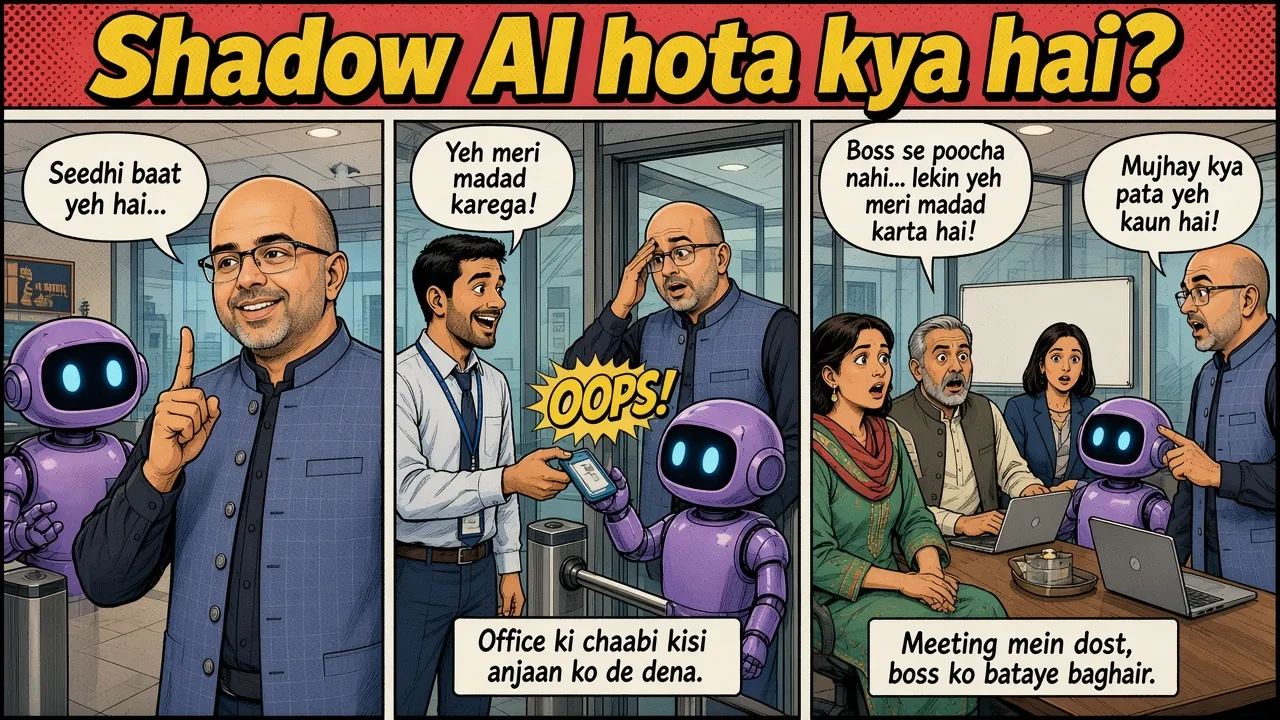
A few days ago I wrote about a friend who called me, worried.
"Munaf, how does this AI tool have my data?"
Lekin ek aur sawal reh gaya. Who approved that tool in the first place?
In too many offices, the honest answer is: nobody.
I'm not saying every AI service trains on everything we submit. Terms, account types and settings differ. But if nobody approved the tool, nobody is reading those terms. Nobody is asking where the data is stored, who can see it, or how long it is kept. And if something goes wrong, the first question is a familiar one:
"Yeh tool laya kisne? Approve kisne kiya?"
Kisi ne nahi.
We used to call this kind of thing shadow IT. After a conversation on forgotten and inherited systems, Muhammad Ather (Founder, Secure Wave Advisors, a cybersecurity consultant) replied with a point that stuck with me:
"Shadow IT is the other blind spot: the file-sharing app a team signed up for, or the tool someone connected with a personal email. Nobody approved it, so nobody owns it or patches it, and attackers love that. And now with teams inclined towards picking their own AI tools, shadow IT is a bigger problem."
Shadow AI is the new shadow IT, only faster. That is the data leak nobody approved.
A day in a Pakistani office
The office below is fictional — not a report about any real firm. Lekin aap ne is ki koi na koi soorat zaroor dekhi hogi. From morning chai to the evening deadline, here is what really happens, the risk in plain words, and a karna kya hai for tomorrow.
9:00 AM — chai, and the WhatsApp group
The kettle is on. A sales colleague photographs a handwritten client list into the work WhatsApp group: "Bhai, isko thora decent bana ke bhej do." Someone replies with a screenshot from a free chatbot. Chai is still hot. The list is already on personal phones, and in a tool nobody approved.
Karna kya hai: Tomorrow, one message from the group admin: no client lists, CNICs or contracts in this chat. Files move through the official drive, not through a photo and a chatbot.
10:30 AM — the sales proposal
A mid-career colleague pastes a full client list into a free chatbot: "Bhai, isko thora professional bana do." The proposal looks sharper. The names, phones and last year's prices are now sitting in a tool nobody approved. You cannot unsay a prompt.
Karna kya hai: Before any prompt, take the real names, phones and prices out. Use dummy figures if you only need help with the English. If the office has an official AI tool, use that one.
12:00 PM — the HR increment sheet
The increment sheet will not add up, and the deadline is today. Someone uploads the full salary file to a website that promises to "fix Excel in seconds." The totals work. Every name, designation and figure just left the building. A public website is not your HR system.
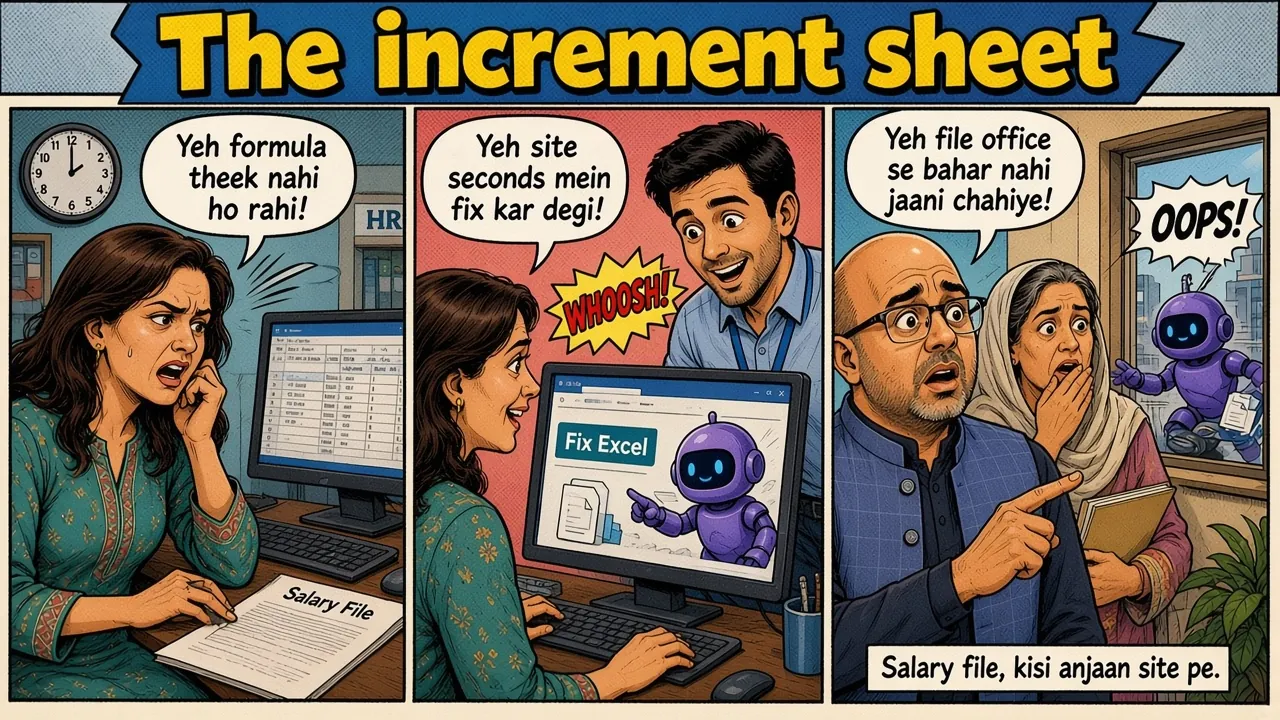
Karna kya hai: Tomorrow, the HR lead says it in one sentence: salary files stay on the HR computer, or in the official system — never on a public website.
2:30 PM — accounts, month-end, a tax notice
A colleague in accounts pastes a tax notice, the NTN and the office address into a chatbot: "Please draft a polite reply, yaar." The English comes back clean. An NTN and a tax demand are official records, and that tool was never approved.
Karna kya hai: Tax notices go to your tax advisor, or to the official software you already use. Before month-end, a reminder: no NTNs, no full notices, no bank statements in a prompt.
3:30 PM — the IT guy
IT has been asked to "block ChatGPT." He knows what happens next: the same tool moves to a phone, and he sees even less. A better afternoon: he walks the floor with a notebook. "Kaun si AI tools already use kar rahe ho?" The intern names three. A manager names one more. That is Discover, over chai.
Karna kya hai: Tomorrow, IT — or the office manager, in a small firm — asks each team that one question, and writes the answers down. You cannot protect what nobody knows exists.
4:30 PM — the boss's meeting, and an AI note-taker
A busy manager lets a free AI note-taker join the boss's meeting "sirf minutes ke liye." It records the talk about a late payment and a difficult customer, and keeps the transcript on a server the company has never seen. If the note-taker was never approved, the minutes are already outside the room.
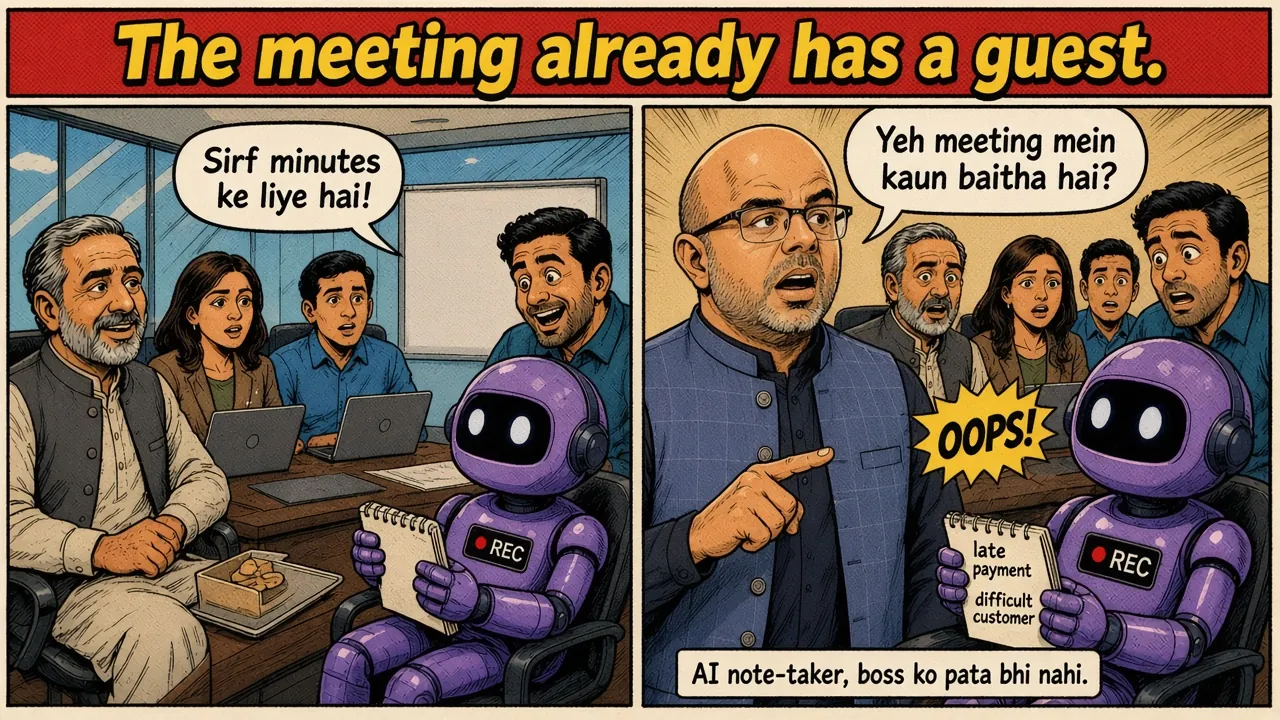
Karna kya hai: At the start of every meeting, one rule: no AI note-taker unless it is on the approved list. If a bot appears, it leaves. Minutes stay with a person.
6:30 PM — the evening deadline
The file is due at seven. The official route feels slow. A free chatbot is one paste away. This is the hour when most of the day's data is at risk, because haste feels like a reason.
Karna kya hai: Before the next deadline week, a short reminder from the boss: deadline pressure is not a reason to paste a file into a tool we don't know.
What has happened in Pakistan
This is no longer only a private worry. On 1 October 2026, National CERT issued advisory NCA-18.011026, on the safe and secure use of generative AI tools. It is Pakistan's official Shadow AI warning. In plain words: do not put sensitive data into unapproved AI tools; keep a list of the tools that are approved; train your staff; and if an AI-related incident happens, report it to National CERT.
This was not the first caution. In 2024, National CERT already advised careful use of AI chatbots (advisory NCA-20). In June 2024, the Cabinet Division issued a similar note: do not enter official data into public chatbots.
Has a Pakistani office already leaked data because someone pasted it into ChatGPT? In public reporting from 2023 to 2026, no well-documented case of that kind was found. That does not mean it has never happened. It only means we should be honest about what we can show.
What we can show is a little different. In May 2025, a security firm, UpGuard, reportedly found a misconfigured AI platform — Langflow, a tool used to build chatbots — at a Pakistani vendor, Workcycle Technologies. About 97,000 insurance customer records were exposed. The opening was reportedly closed within about two days, and UpGuard said there was no evidence that anyone had used the data. This was not a ChatGPT-paste story. It was an AI platform at a vendor, left open in the wrong way.
The clear global example of pasting work into ChatGPT is Samsung, in 2023. Engineers there were reported to have put source code and meeting notes into the tool. The company later banned generative AI on work computers.
In January 2026, a senator told a Senate committee that NADRA, FBR and bank data was on the dark web, and alleged insider involvement. That is a claim made in committee, not a confirmed official breach report, and it is not a Shadow AI incident. It is a reminder: once personal data leaves, it is very hard to call back.
Banks and payment companies already answer to the State Bank of Pakistan on customer information and third-party risk, including standing rules on cloud and outsourcing. Listed companies have SECP to consider; telecom has PTA. As of this writing, SBP, SECP and PTA have not issued a circular specifically on generative AI. In April 2025, it was reported that SBP was working on guidelines for responsible AI use in financial services. The official Shadow AI warning we do have is National CERT's advisory of 1 October 2026.
Pakistan's Personal Data Protection Bill, still a draft, would ask a harder question: if personal data went into a tool nobody approved, who is accountable? "Yeh mera area nahi hai" will not be a comfortable answer. This is not a reason to panic. It is a reason to get practical.
We cannot simply say "don't use it"
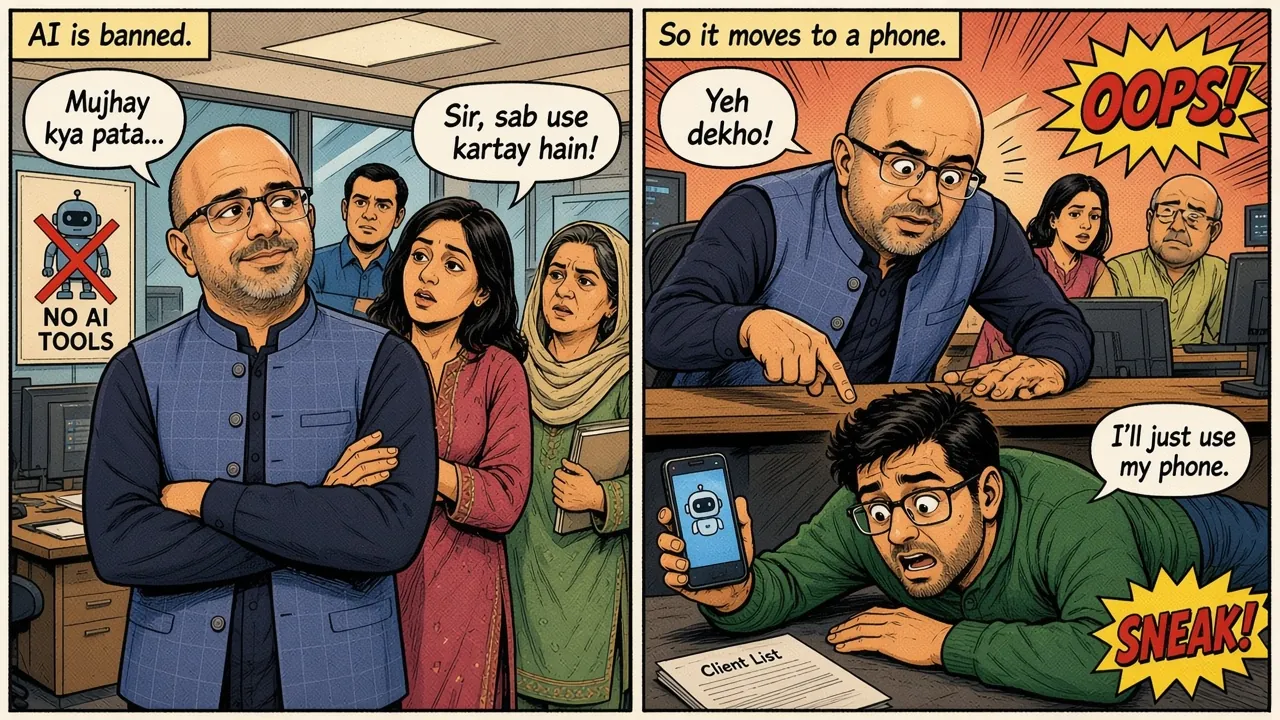
We have to learn to live with AI. We cannot tell people not to use it when it is already helping them do their jobs. A ban, on its own, usually has one result: the tool moves to a personal phone, and IT sees even less.
Five habits this quarter
Theek hai. So what can we actually do, without a huge budget or a year-long project? I would start with five habits. Discover. Own. Offer. Govern. Monitor.
Discover. Start with an honest list. Ask the teams, the way the IT guy did at 3:30: which AI tools are already in use? You will not catch everything on day one. You will catch more than you think.
Own. For each tool that stays, name a person — not "IT" as a department. "Zimmedar kaun hai?" should have a short answer. If you cannot find an owner, that may be a tool you should switch off.
Offer. This is the step most bans forget. Give people an official tool that actually helps them do the same work. For some organisations, a licensed company tool with the right settings. For more sensitive work, private inference: the AI works on your data in a place you control. Not every organisation needs to build its own setup. Every organisation does need an official answer to "Phir use kya karoon?"
Govern. You do not need a hundred-page policy. You need a page people will actually read: what can go into an approved tool, what can go only into a private one, and what must never go into a public AI tool at all — customer data, CNICs, contracts, source code, salary files, tax notices. Anything you would not put on a postcard.
Monitor. A policy that nobody checks is just a wish. When a team wants a new tool, make the official route faster than the unofficial one. You don't need to spy on people. You need enough visibility to notice when a new door has opened, and enough trust that staff will tell you first.
Why these five? Because Shadow AI does not stay on one desk. It spreads.
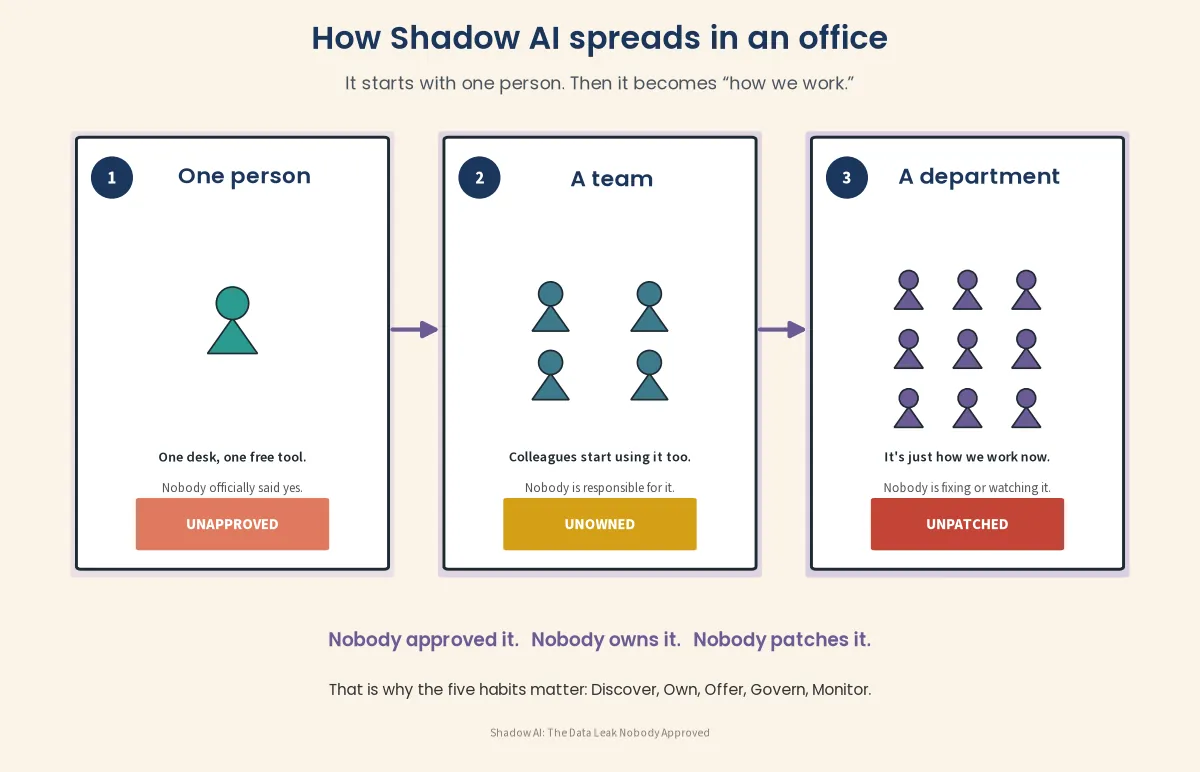
If you run a small firm, this does not require a full-time CISO. Write the tools down, pick one official option if you can, say what must never be pasted in, name who is responsible, and review it in a month.
If you are the CIO or the CISO, this is not a problem you can forward to each other. Both need a seat when tools are chosen, and the authority to offer a real alternative, not only to say no.
A few questions I would sit with
- Do we actually know which AI tools our people are using today?
- Does each one have a named owner?
- Have we given teams a good enough official alternative, so they don't feel the need to go around IT?
- Have we told them, in plain language, what must never go into a public AI tool?
- If customer data left through an unapproved tool tomorrow, would we even know? And could we tell the customer, or the regulator, where it went?
I would like to hear from CIOs, CISOs, business owners and policymakers. What is already working in your organisation? Where are you still finding tools you didn't know you had?
Key takeaways
- Shadow AI is the data leak nobody approved. In a normal office day, staff paste client lists, salary files, tax notices and meeting talk into free tools that never went through IT.
- It matters here, now. National CERT has already issued an official Shadow AI warning (NCA-18.011026, 1 October 2026). SBP, SECP and PTA have not issued a generative-AI circular of their own, but banks and listed firms already answer to them on customer data. Pakistan's Personal Data Protection Bill, still a draft, would ask who is accountable.
- A ban does not work. People will use AI anyway. Tell them "don't use it," and the tool often just moves to a personal phone.
- Five habits this quarter: Discover, Own, Offer, Govern, Monitor. And at each desk, a karna kya hai you can start tomorrow — strip real names before a prompt, keep salary files off public sites, keep tax notices with the advisor, ask teams which tools they already use, and allow no unapproved note-taker in the meeting.
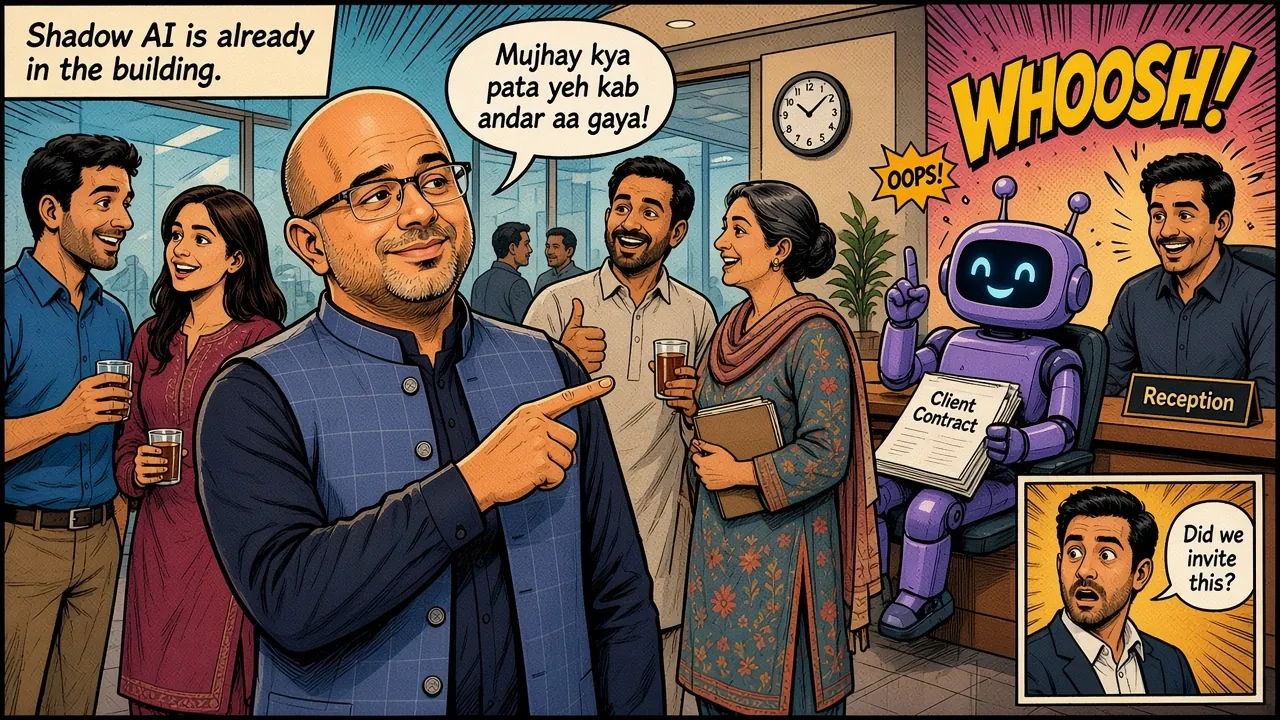
Shadow AI is already in the building. The question is whether we invited it, and whether we are still in charge of what it can see.
Sources
- National CERT, Advisory NCA-18.011026, "Safe and Secure Use of Generative Artificial Intelligence (GenAI) Tools and Platforms," 1 October 2026. https://pkcert.gov.pk/advisory/26/18.pdf
- National CERT, Advisory NCA-20.102324, "Cautious Usage of AI-Driven Chatbots," PDF dated 4 November 2024. https://pkcert.gov.pk/advisory/24-20.pdf
- Cabinet Division (NTISB), Advisory No. 09 of 2024, "Cyber Security Threats and Privacy Concerns — Cautious Usage of AI Driven ChatBots," 10 June 2024. https://download1.fbr.gov.pk/Docs/20247111375859708Advisory09of2024.pdf
- UpGuard, report on a misconfigured Langflow instance used by Workcycle Technologies, 12 August 2025. https://www.upguard.com/breaches/workcycle-tpl-langflow-leak-pakistan
- The Register, report on Samsung engineers and ChatGPT, 6 April 2023. https://www.theregister.com/software/2023/04/06/samsung-reportedly-leaked-its-own-secrets-through-chatgpt/895536
- The Korea Herald, report on Samsung's generative-AI ban on work devices, 3 May 2023. https://www.koreaherald.com/article/3118116
- Dawn, "Regulations for AI use in banks on the cards," 27 April 2025. https://www.dawn.com/news/1906849
- Dawn, report of a Senate allegation on NADRA, FBR and bank data, 21 January 2026. https://www.dawn.com/news/1968167
- State Bank of Pakistan, BPRD Circular No. 04 of 2020, cloud-outsourcing rules (standing guidance, not an AI circular). https://www.sbp.org.pk/bprd/2020/C4.htm
About the author
I am the Founder & CEO of Server4Sale. My time as Co-Chair of Industry Engagement at P@SHA gave me a view of both the vendor side and the practitioner side. My work as Chair Cyber at FPCCI gave me insight into the concerns of CISOs, security experts and government policymakers. I don't pretend there is one answer for every organisation. I do believe we can close this gap with habits we can start this quarter, not with a project we will start next year.
Quick answers
Frequently asked questions
What is Shadow AI?
Any AI tool people use for work without the company knowing, approving or protecting it: a free chatbot, a browser extension, or an AI tool opened with a personal email. Nobody approved it, so nobody owns it.
Why doesn't banning AI tools work?
A ban on its own usually has one result: the tool moves to a personal phone, and IT sees even less. People need an official tool that actually helps them do the same work.
What has National CERT advised about generative AI?
On 1 October 2026 National CERT issued advisory NCA-18.011026 on the safe and secure use of generative AI tools: do not put sensitive data into unapproved AI tools, keep a list of approved tools, train staff, and report AI-related incidents to National CERT.
What are the five habits to manage Shadow AI?
Discover which AI tools are already in use, Own each one with a named person, Offer an official alternative, Govern with a one-page rule on what can go where, and Monitor so that the official route is faster than the unofficial one.
What should never go into a public AI tool?
Customer data, CNICs, contracts, source code, salary files and tax notices. Anything you would not put on a postcard.
From LinkedIn
What people are saying
“Munaf, the 3:30 PM scene is the one that matters most. An IT lead with a notebook and one question will surface more than a blocklist ever will, because a block changes where the tool runs, not whether it runs. One observation from governance work: Shadow AI is usually a service…”
“We see the same pattern across Southeast Asia — blocking AI tools mostly pushes usage onto personal phones, where you lose visibility altogether. What works better is offering a sanctioned option and then controlling what sensitive data can go into prompts, rather than which…”
“Thank you for the mention Munaf bhai and taking the shadow IT point further. Comic style artwork is too good 💯 Just few things from myside, I think the bigger blind spot is Staff connecting AI tools to work email, Drive and calendars through OAuth, and that access stays alive…”
“Well articulated, Mohammad Munaf Majeed bhai. These use cases are real and relatable. When every dashboard is green, it’s easy to let our guard down while unapproved AI use goes undetected. I agree that we need to learn to work with AI. In practice, that means helping employees…”
“The real issue is that AI is being adopted at the individual level, not the company level. Companies need to adopt first, with the right tools and the right licensing. That's the only way to actually control how AI is used and avoid leaks like these. The ones who start investing…”
Selected comments from the LinkedIn post, shown as excerpts. Dates are approximate.
Read all 19 comments on LinkedIn ↗